
Fundamentals of Geometry

Key Concepts

Solved Examples: 12

Practice Questions: 3
Solved Examples
Question 1: Determine the value of “a” in the figure considering that the two horizontal lines are parallel to each other.
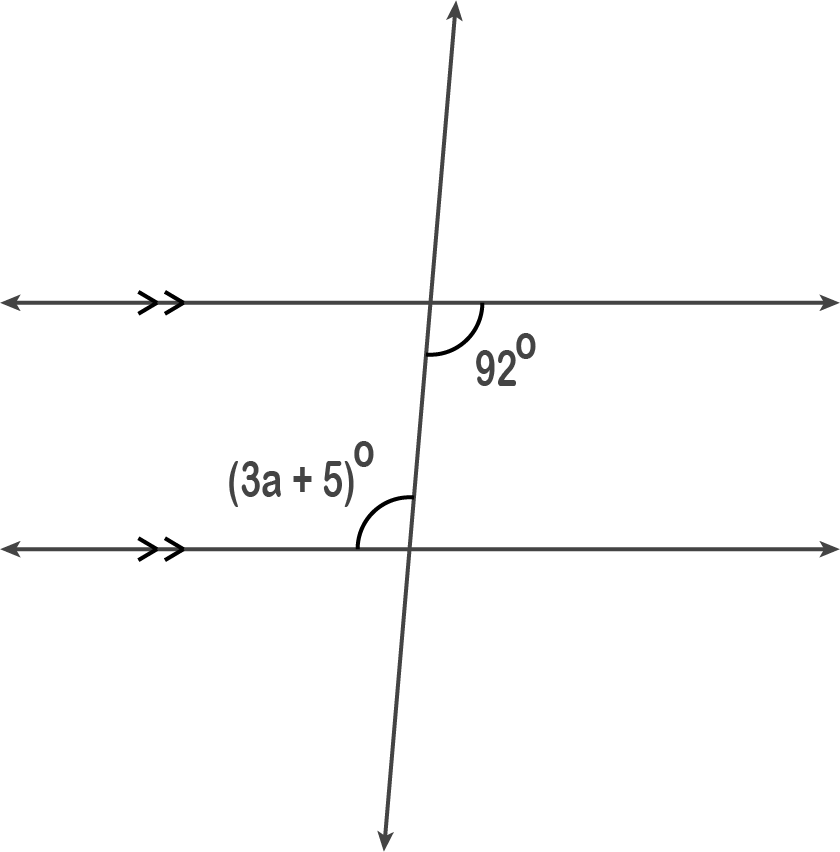
The angles ∠92° and ∠(3a + 5)° are alternate interior angles and are therefore equal.
So, ∠(3a + 5)° = ∠92°
or, 3a + 5 = 92
or, 3a = 87
or, a = 29
Question 2: In the given figure AB || DF and BC || EG. If ∠GEF = 64°, ∠ABH = 27° the find the value of ∠BEG
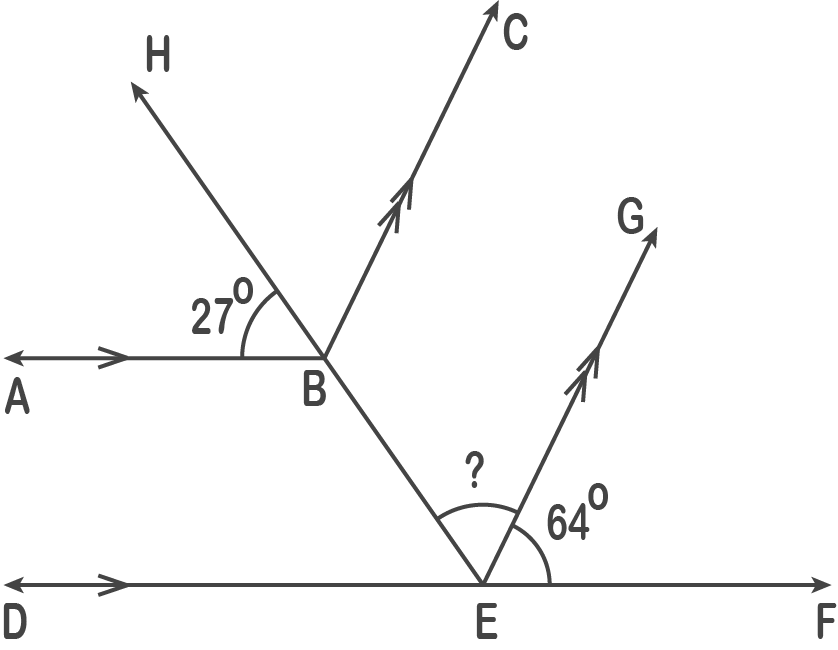
AB || DF and EH is transverse, so to it ∠ABH = ∠DEB 27° since they are corresponding angles.
Since ∠DEF is a straight angle
∠BEG = ∠DEF – ∠DEH – ∠GEF
or, ∠BEG = 180° – 64° – 27° = 89°
Question 3: In the given figure lines AB and CD intersect at O. OE is another straight line originating from the intersection point O such that ∠BOE = 80°. If ∠BOD = 30° then find the value of ∠COE.
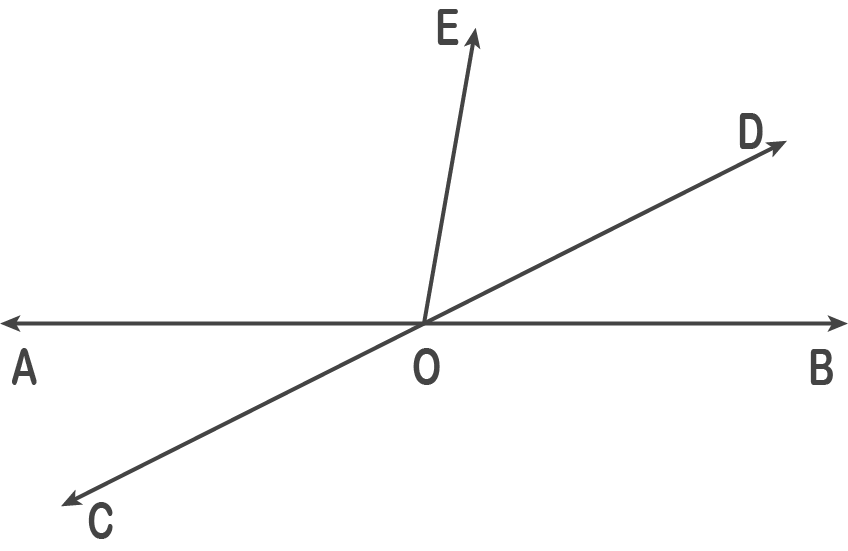
Given ∠BOE = 80° and ∠BOD = 30°
So ∠DOE = 80° – 30° = 50°
In straight angle ∠AOB
∠AOE = ∠AOB – ∠BOE
∠AOE = 180° – 80° = 100°
Again ∠AOC = ∠BOD = 30° (Vertically opposite angles)
So ∠COE = ∠AOC + ∠AOE
or, ∠COE = 30° + 100° = 130°
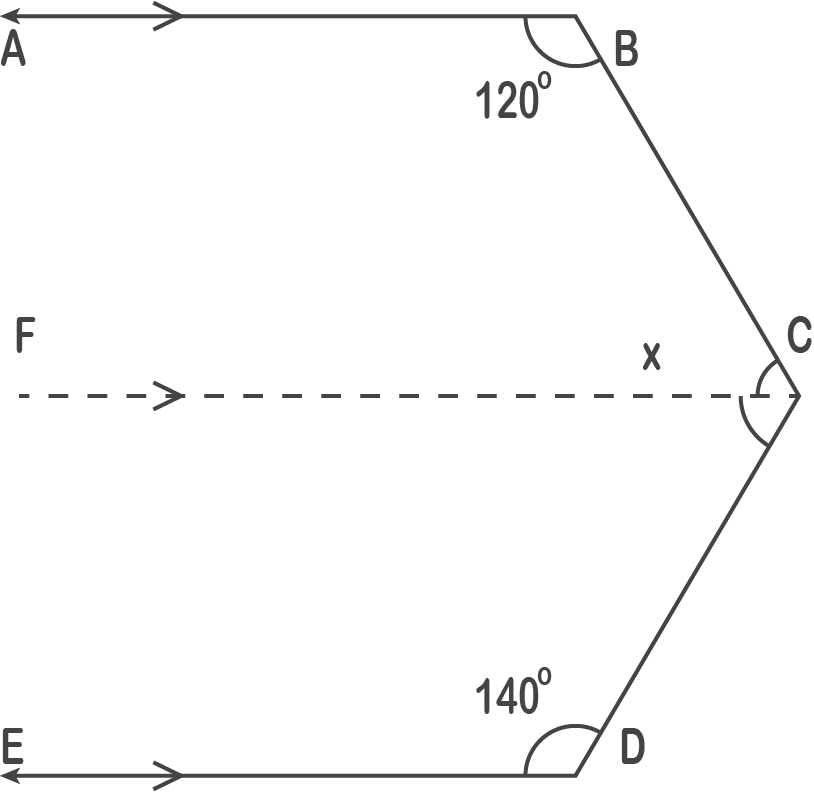
Question 4: In the given figure AB || DE find the value of x.
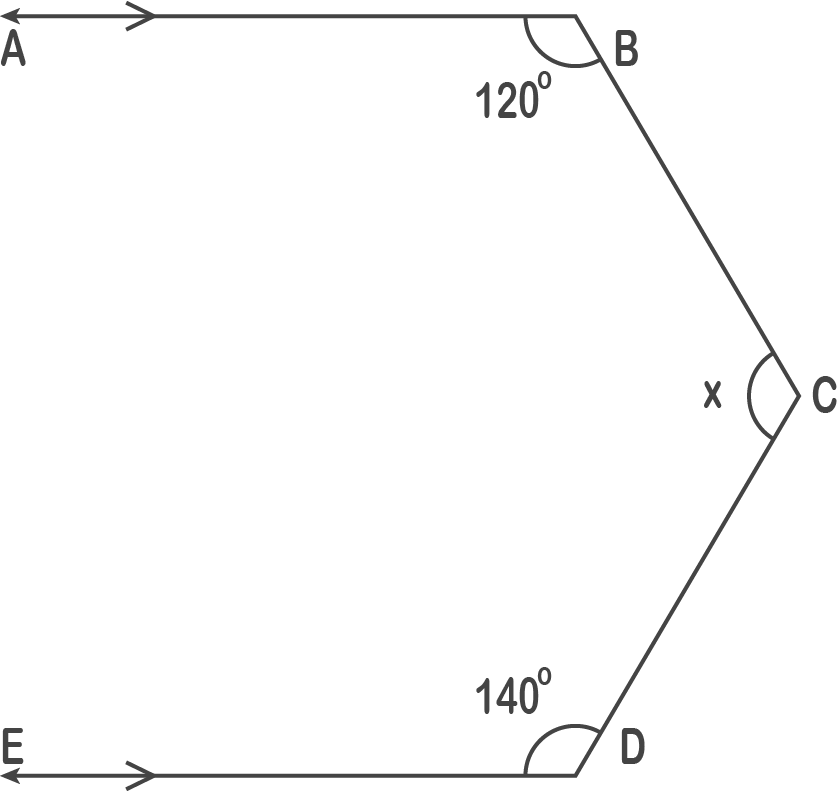
Draw a line CF parallel to AB and DE.
AB || CF and BC is the transverse line
again DE || CF and CD is the transverse line
∠ABC and ∠FCB are supplementary angles
∠FCB = 180° – 120° = 60°
again ∠CDE and ∠DCF are supplementary angles
∠DCF = 180° – 140° = 40°
So x = ∠BCF + ∠DCF = 40° + 60° = 100°
Question 5: In the figure below PQ || RS, ∠BPQ = 40°, ∠BPR = 155° and ∠CRS = 70°. Find the value of ∠PAR.
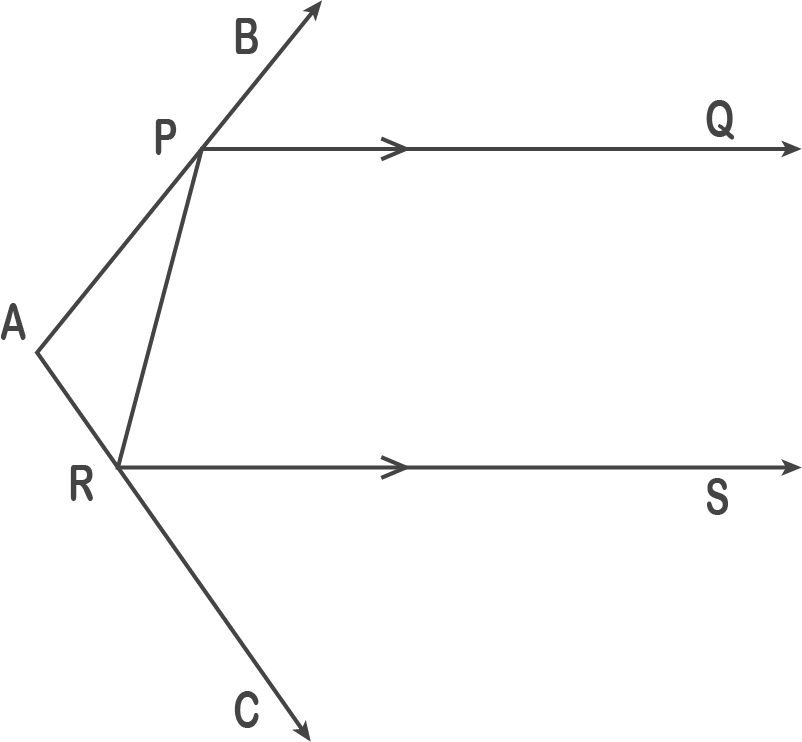
∠APR = ∠APB – ∠BPR
∠APR = 180° – 155° = 25°
Again
∠RPQ = ∠BPR – ∠BPQ
∠RPQ = 115° – 40° = 115°
Given PQ || RS and PR is transverse
So ∠RPQ and ∠PRS are supplementary
∠PRS = 180° – 115° = 65°
∠ARP = ∠ARC – ∠CRS – ∠PRS
∠ARP = 180° – 70° – 65° = 45°
∠PAR = 180° – 25° – 45° = 110°
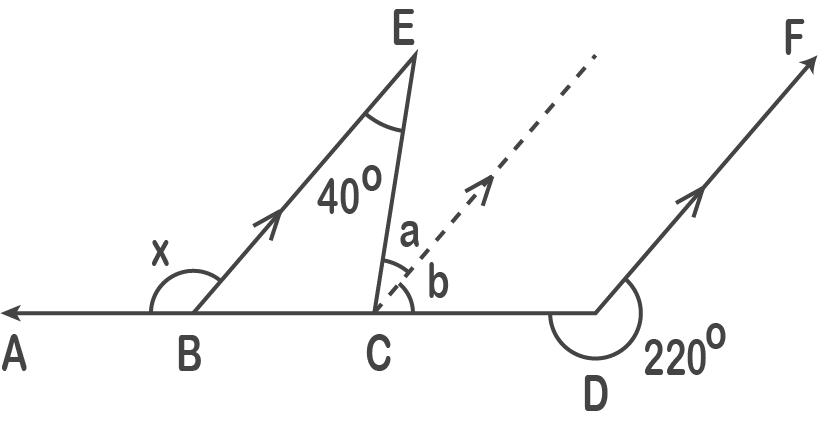
Question 6: In the given figure if BE || DF, the calculate the value of x and y.
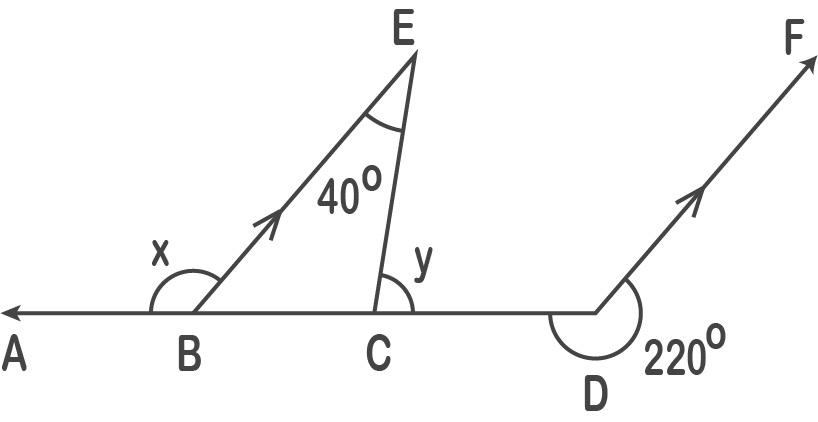
We construct a line CG parallel to BE and DF
∠c = 360° – ∠CDF
∠c = 360° – 220° = 140°
CG || DF and CD is the transversal
∠b + ∠c = 180° (supplementary angles)
So, ∠b = 180° – 140° = 40°
Again BD || CG and CE is tthe transversal
∠a = ∠BEC = 40° (Alternate angles)
So, y = ∠a + ∠b = 40° + 40° = 80°
∠BCE = ∠BCD – ∠y
∠BCE = 180° – 80° = 100°
∠x = ∠BEC + ∠BCE
∠x = 100° + 40° = 140°
Question 7: Find the value of x in the given figure.
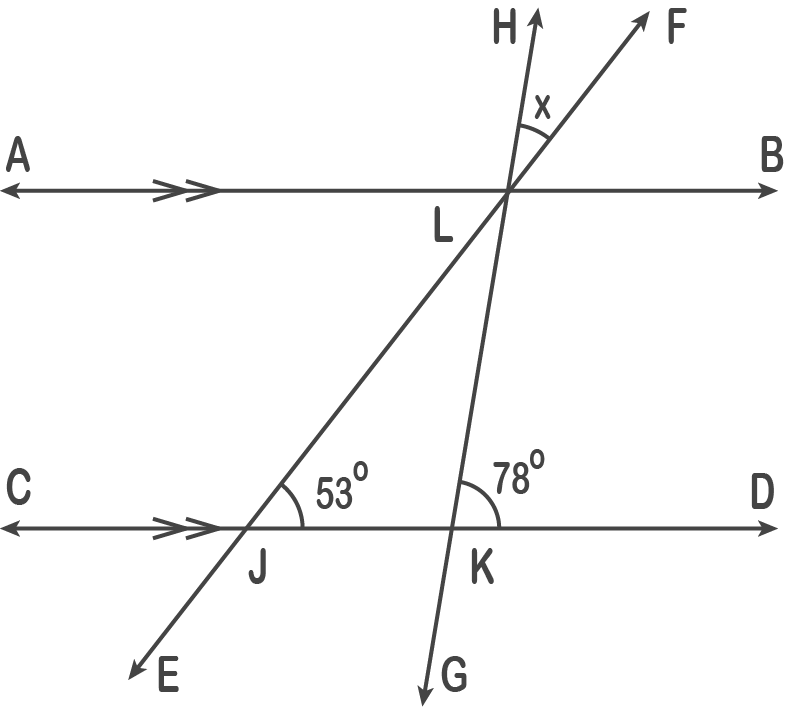
∠JKL = ∠JKD – ∠LKD
∠JKL = 180° – 78° = 102°
∠JLK = 180° – ∠JKL – ∠LJK
∠JLK = 180° – 53° – 102° = 45°
x = ∠JLK = 45° (vertically opposite angles)
Question 8: Find the values of x and y in the given figure.
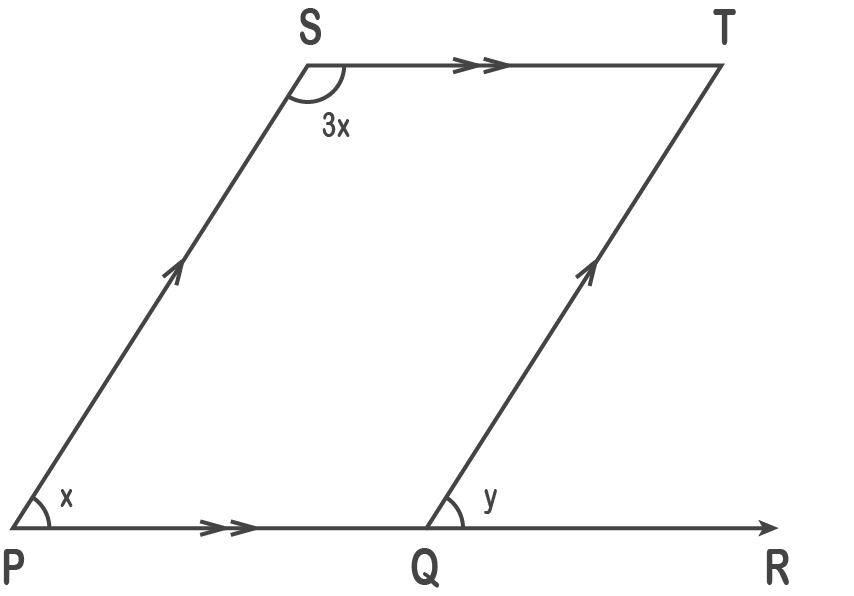
So, x + 3x = 180°
or, x = 45°
So y = x = 45°
Question 9: Find the values of x and y in the given figure.
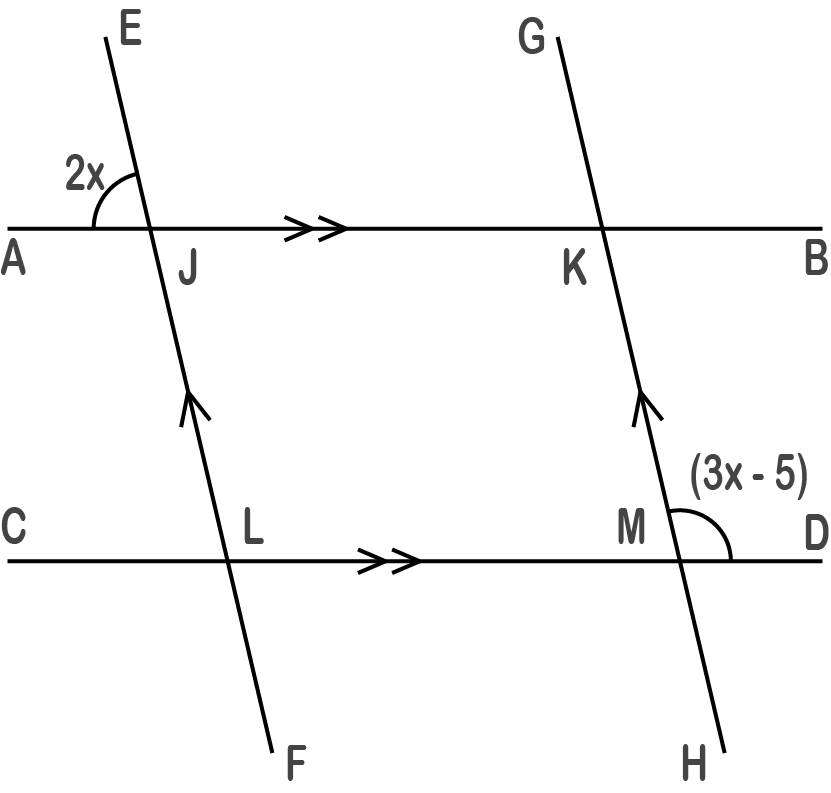
∠KMD = ∠GKB = (3x – 5) congruent angles
∠GKJ = 180° – (3x – 5)
Since ∠GKJ = ∠EJA congruent angles
we have
180° – (3x – 5) = 2x
or, 5x = 185°
or, x = 37°
Question 10: Find the value of y from the given figure where AC || DF.
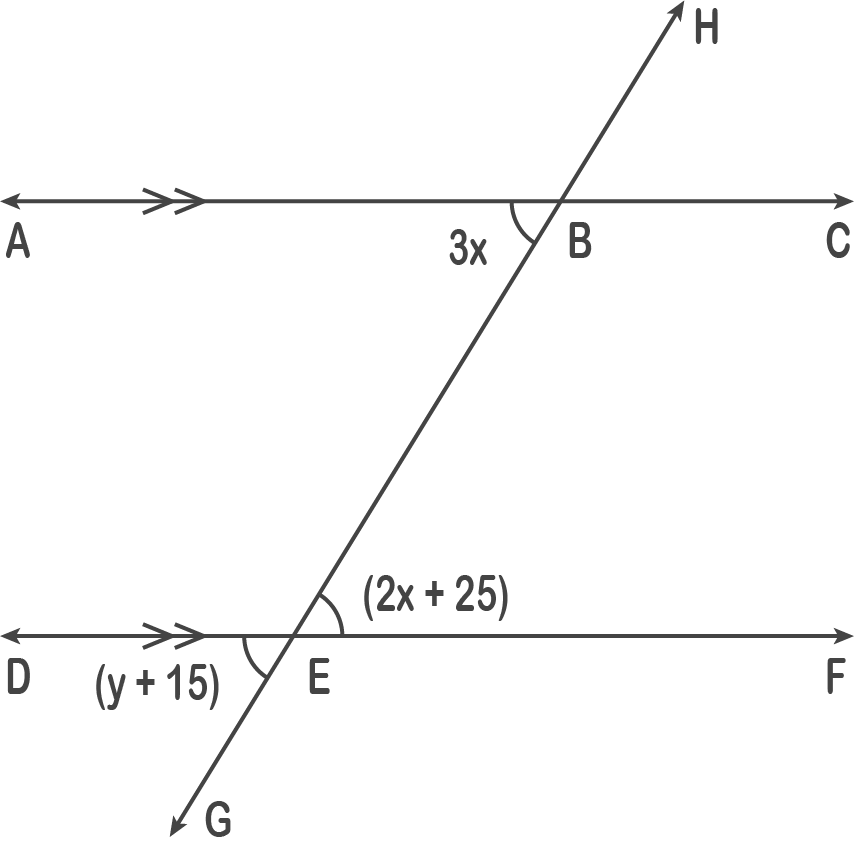
Since AC || DF and GH is the transversal
∠ABE = ∠BEF corresponding angles
So, 3x = 2x + 25
or, x = 25°
∠BEF = 2 x 25° + 25° = 75°
Now, ∠BEF = ∠DEG vertically opposite angles
So (y + 15)° = 75°
or, y = 60°
Question 11: For what value of Y is the seven-digit number 46393Y8 divisible by 11?
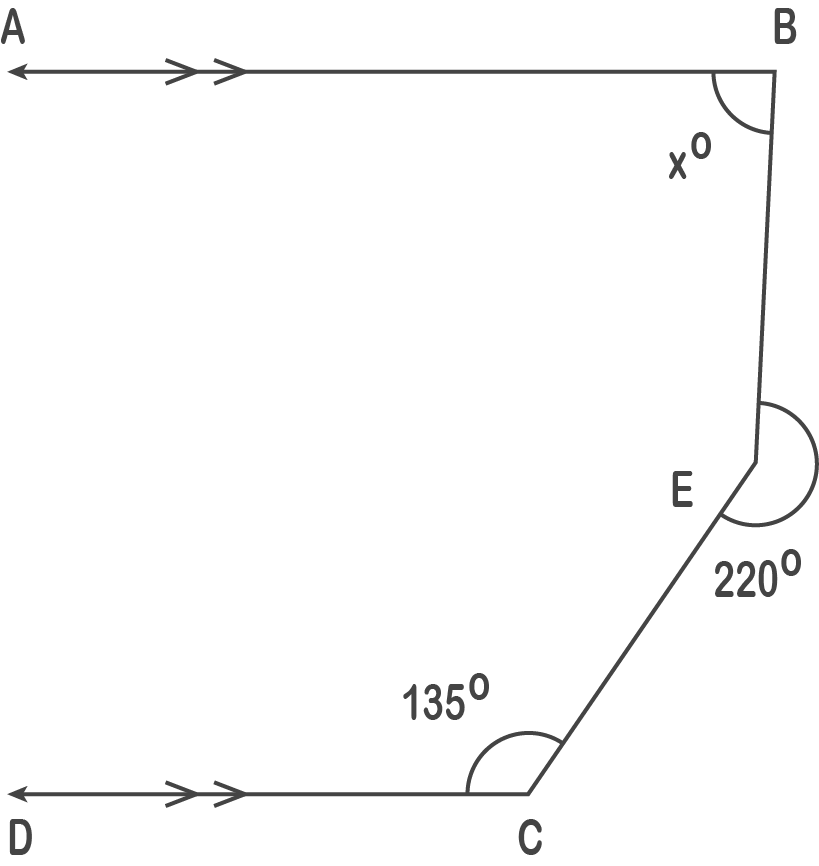
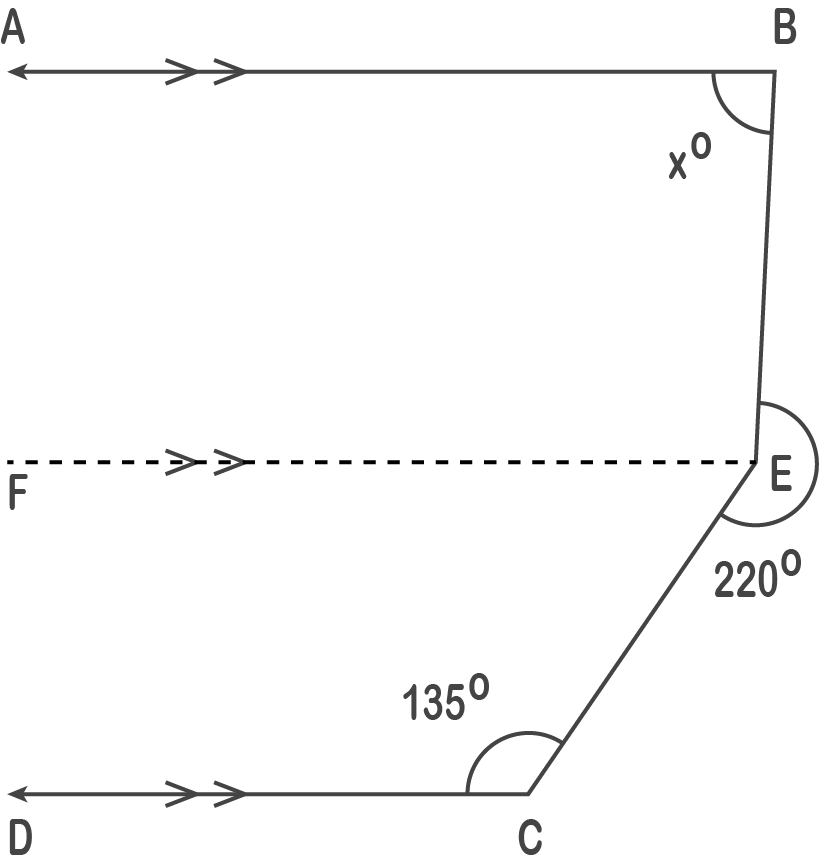
Construct FE parallel to AB and CD
Since FE || DC and CE is transversal
∠DCE = ∠FEC are supplementary angles
So ∠FEC = 180° – 135° = 45°
∠FEB = 360° – ∠CEB – ∠FEC
∠FEB = 360° – 220° – 45° = 95°
Since FE || AB and BE is transversal
∠FEB and ∠ABE are supplementary angles
So ∠ABE = 180° – 95° = 85°
Question 12: Find the value of x in the given figure.
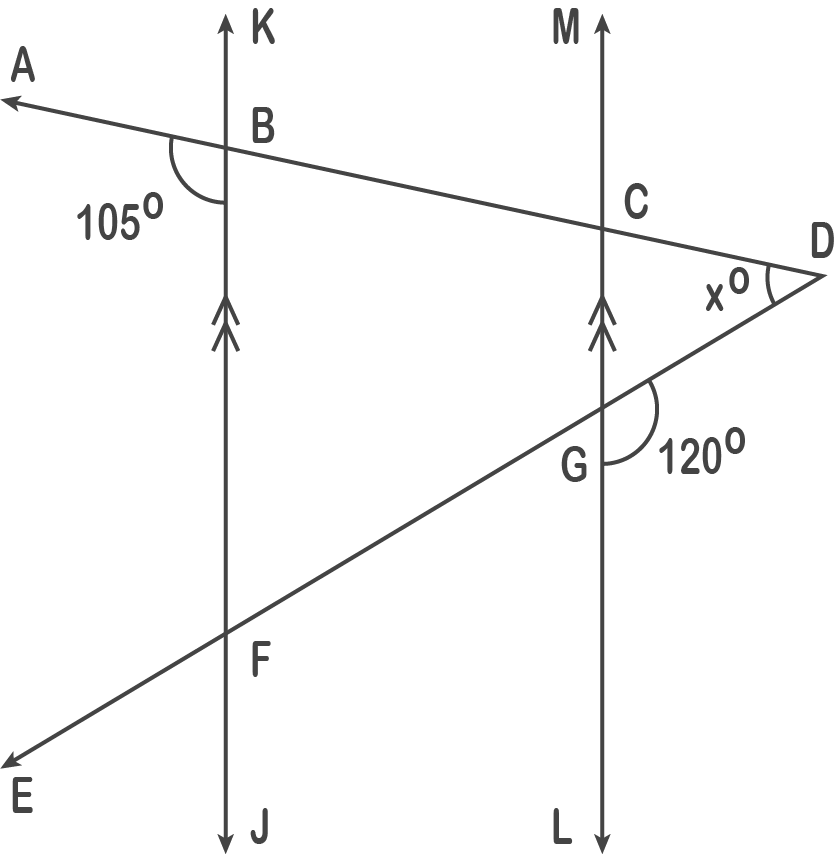
JK || LM and AD is transversal
∠ABF = ∠ACL = 105° consecutive angles
∠GCD = 180° – 105° = 75° supplementary angles
∠CGD = ∠MGL – ∠DGL
∠CGD = 180° – 120° = 60°
In triangle CGD
∠CDG = 180° – 75° – 60° = 45°
Fundamentals of Geometry
Lines can be classified according to their positions relative to one another.
Parallel lines are lines in the same plane that never intersect, regardless of how far they are extended. The distance between them always remains constant.
Intersecting lines are lines that meet at exactly one point.
Perpendicular lines are intersecting lines that form four equal right angles of 90°.
Recognising these relationships is essential because many geometry problems are based on the angles formed when lines intersect or when a transversal cuts parallel lines.
Points, Lines, Rays and Line Segments
Geometry is built on a few basic concepts. A point represents an exact location and has no length, width, or thickness. A line extends infinitely in both directions and has no endpoints. A line segment is a part of a line with two fixed endpoints, so its length can be measured. A ray starts from a fixed point and extends infinitely in one direction.
Angles and Their Classification
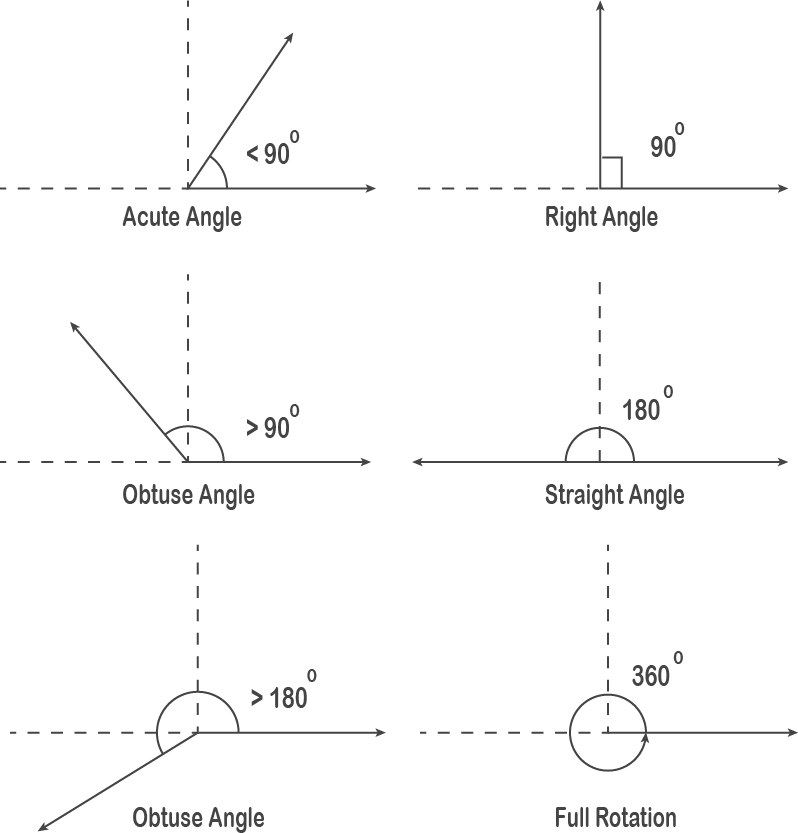
The main types are:
Acute: Less than 90°
Right: 90°
Obtuse: Between 90° and 180°
Straight: 180°
Reflex: Between 180° and 360°
Complete: 360°
Relationships Between Angles
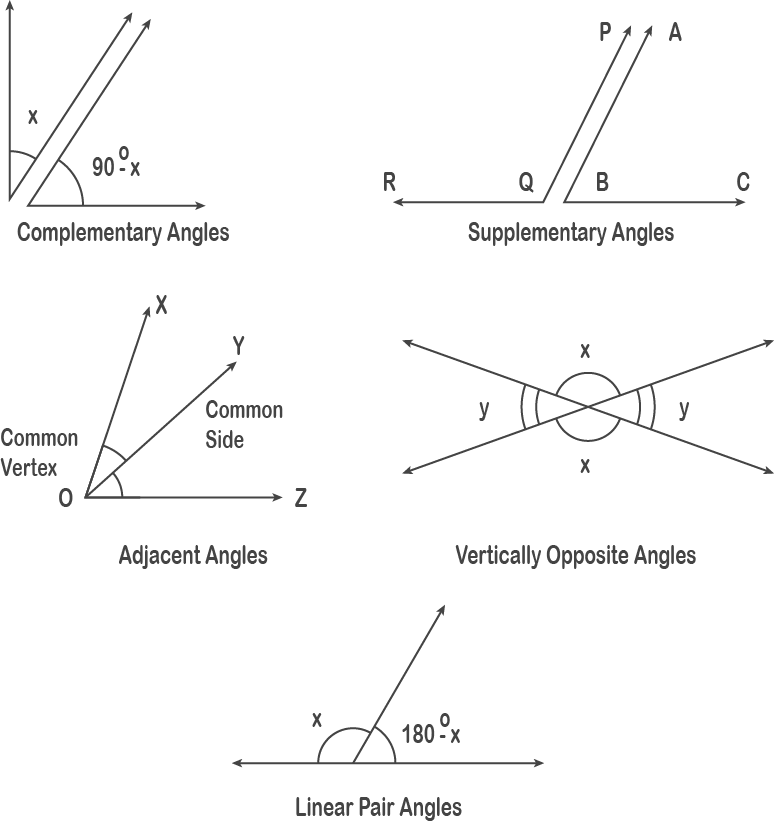
Complementary angles add up to 90°.
Supplementary angles add up to 180°.
Adjacent angles share a common vertex and arm.
Vertically opposite angles are equal.
A linear pair consists of two adjacent angles whose sum is 180°.
Parallel Lines and a Transversal
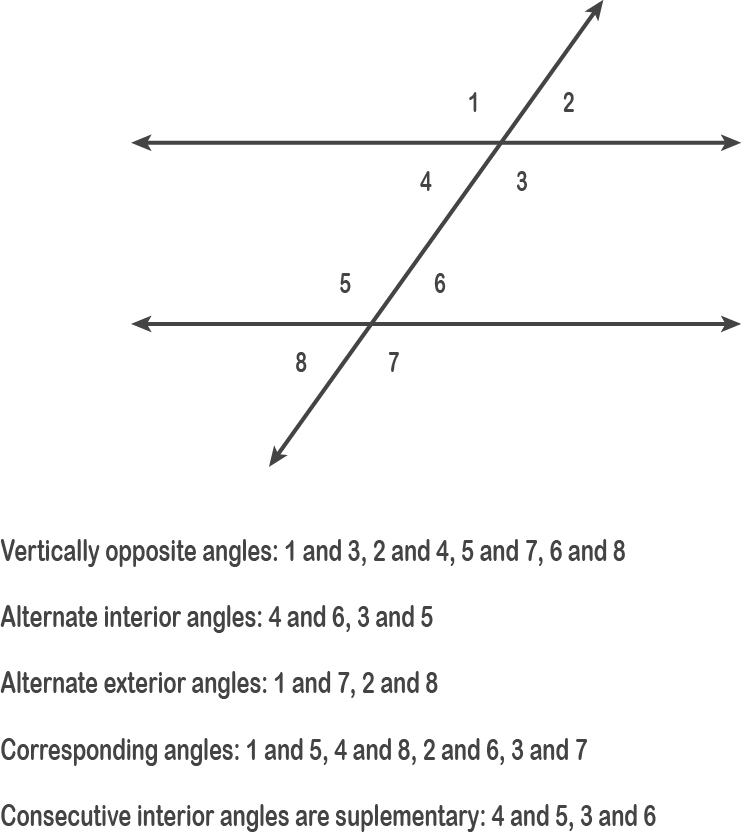
Corresponding angles are equal.
Alternate interior angles are equal.
Alternate exterior angles are equal.
Co-interior angles add up to 180°.

Summary of Fundamentals of Geometry
| Concept | Summary |
|---|---|
| Point | An exact location with no length, width, or thickness. |
| Line | A straight path extending infinitely in both directions. |
| Line Segment | A part of a line with two endpoints and a measurable length. |
| Ray | A part of a line with one endpoint extending infinitely in one direction. |
| Plane | A flat two-dimensional surface extending infinitely in all directions. |
| Parallel Lines | Lines in the same plane that never intersect. |
| Intersecting Lines | Lines that meet at exactly one point. |
| Perpendicular Lines | Intersecting lines that form four right angles (90°). |
| Complementary Angles | Two angles whose sum is 90°. |
| Supplementary Angles | Two angles whose sum is 180°. |
| Adjacent Angles | Two angles sharing a common vertex and a common arm. |
| Vertically Opposite Angles | Opposite angles formed by intersecting lines are always equal. |
| Linear Pair | Two adjacent angles whose sum is 180°. |
| Corresponding Angles | Equal angles formed when a transversal intersects two parallel lines. |
| Alternate Interior Angles | Interior angles on opposite sides of a transversal that are equal. |
| Alternate Exterior Angles | Exterior angles on opposite sides of a transversal that are equal. |
| Co-interior Angles | Interior angles on the same side of a transversal whose sum is 180°. |

Common Mistakes
- Confusing adjacent angles with vertically opposite angles: Adjacent angles share a common arm, whereas vertically opposite angles are equal but do not share a common arm.
- Assuming all pairs of angles add up to 180°: Only supplementary angles and certain angle pairs formed by intersecting or parallel lines sum to 180°.
- Treating complementary angles as supplementary angles: Complementary angles add up to 90°, whereas supplementary angles add up to 180°.
- Assuming vertically opposite angles are supplementary: Vertically opposite angles are always equal, not necessarily supplementary.
- Using the wrong angle relationship in parallel lines: Identify whether the angles are corresponding, alternate interior, alternate exterior or co-interior before applying the correct property.
- Assuming corresponding angles are supplementary: Corresponding angles are equal when the lines are parallel.
- Assuming alternate angles are supplementary: Alternate interior and alternate exterior angles are equal when the lines are parallel.
- Forgetting that co-interior angles are supplementary: Co-interior angles on the same side of the transversal always add up to 180° when the lines are parallel.
- Applying parallel-line properties without confirming parallelism: Angle relationships such as corresponding and alternate angles hold only when the lines are parallel.
- Ignoring the given angle relationships while forming equations: First identify all equal or supplementary angles before writing equations to find the unknown angle.
Practice Questions
Question 1: Find the value of x in the given figure
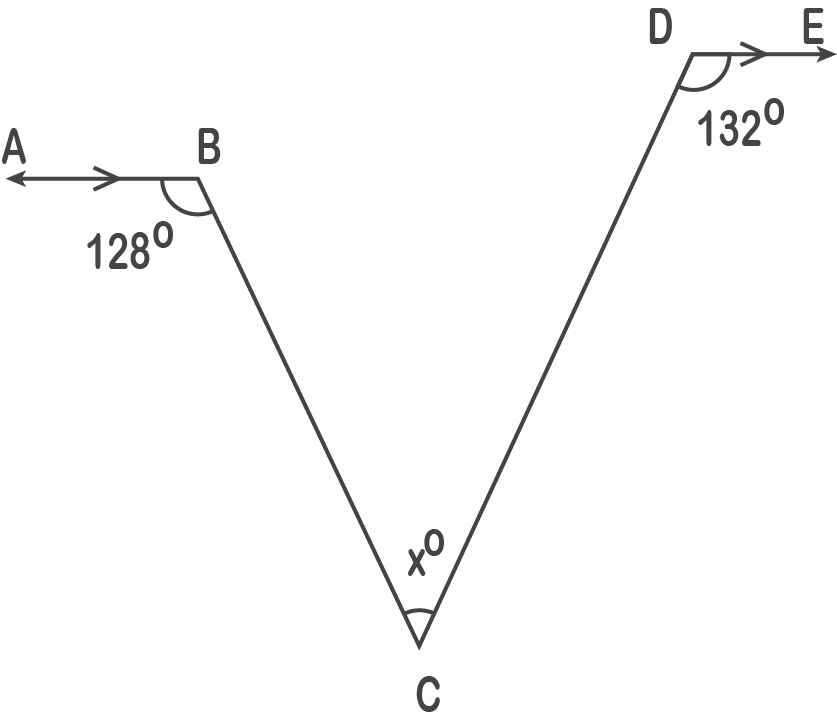
Question 2: Find the value of x in the given figure
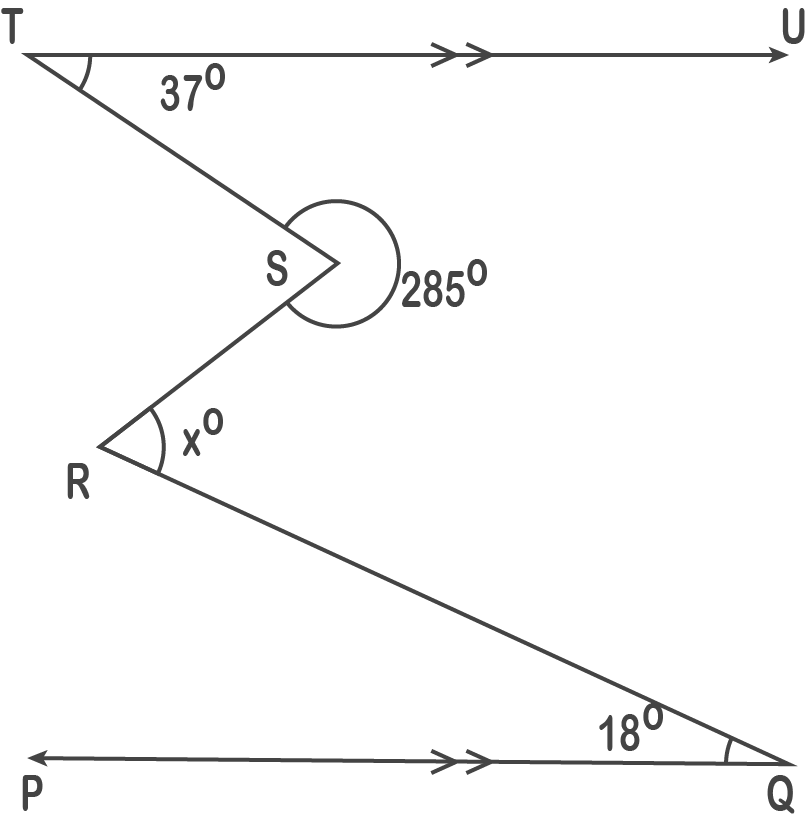
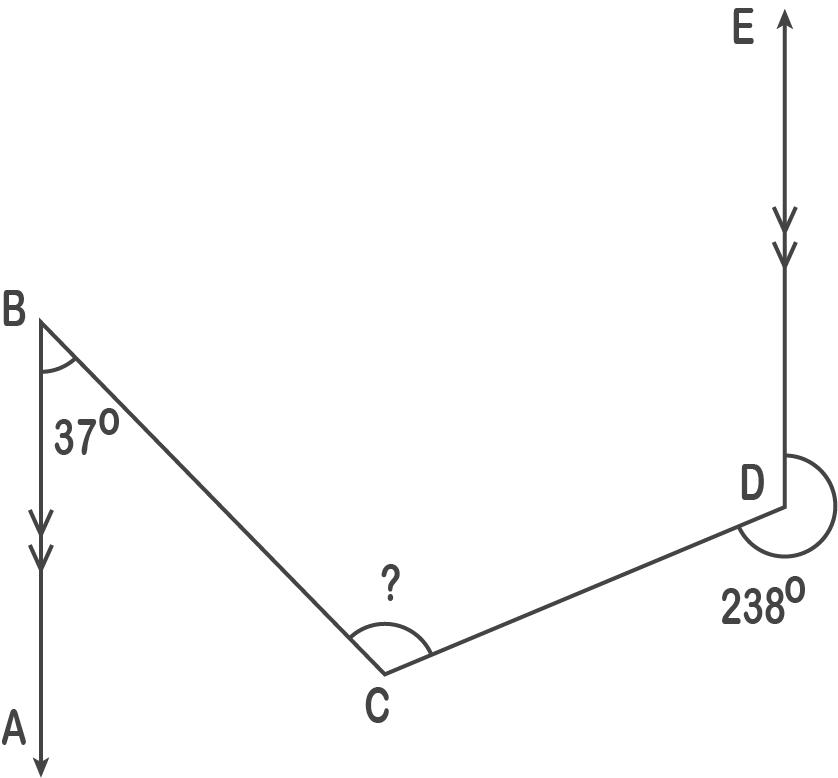
Question 3: Find the value of ∠BCD in the figure given.

Related Topics
 |
|
|
|
|
|