
Trigonometric Ratios

Key Concepts

Solved Examples: 38

Practice Questions: 5
Solved Examples
Question 1: In a right-angled triangle, the hypotenuse is 25 cm and one of the legs is 24 cm. Find sin θ, where θ is the angle opposite the shorter leg.
Other side² = 25² − 24²
= 625 − 576
= 49
Other side = 7 cm
Therefore,
sin θ = Opposite ÷ Hypotenuse
= 7/25
Question 2: A right-angled triangle has legs measuring 9 cm and 12 cm. Find cos θ, where θ is the angle opposite the 9 cm side.
= 81 + 144
= 225
Hypotenuse = 15 cm
Adjacent side to θ = 12 cm
Therefore,
cos θ = Adjacent ÷ Hypotenuse
= 12 ÷ 15
= 4/5
Question 3: The sides of a right-angled triangle are in the ratio 5 : 12 : 13. Find tan θ, where θ is opposite the smallest side.
Adjacent side = 12
Therefore,
tan θ = Opposite ÷ Adjacent
= 5/12
Question 4: In a right-angled triangle, one leg is x cm, the other is 2x cm and the hypotenuse is x√5 cm. Find sec θ, where θ is adjacent to the shorter leg.
Hypotenuse = x√5
Therefore,
sec θ = Hypotenuse ÷ Adjacent
= x√5 ÷ x
= √5
Question 5: The perimeter of a right-angled triangle is 56 cm. Two of its sides are 7 cm and 24 cm. Find cot θ, where θ is opposite the shorter leg.
= 56 − (7 + 24)
= 25 cm
Since
7² + 24² = 25²,
the triangle is right-angled.
Opposite side = 7 cm
Adjacent side = 24 cm
Therefore,
cot θ = Adjacent ÷ Opposite
= 24/7
Question 6: In a right-angled triangle, tan θ = 5/12 and the hypotenuse is 26 cm. Find the lengths of the other two sides.
tan θ = Opposite ÷ Adjacent = 5/12
Let the opposite side = 5x and the adjacent side = 12x.
Using Pythagoras’ theorem,
(5x)² + (12x)² = 26²
25x² + 144x² = 676
169x² = 676
x² = 4
x = 2
Opposite side = 10 cm
Adjacent side = 24 cm
Question 7: In a right-angled triangle, sin θ = 8/17. If the opposite side is 24 cm, find the lengths of the adjacent side and the hypotenuse.
sin θ = Opposite ÷ Hypotenuse
8/17 = 24 ÷ Hypotenuse
Hypotenuse
= (24 × 17) ÷ 8
= 51 cm
Using Pythagoras’ theorem,
Adjacent²
= 51² − 24²
= 2601 − 576
= 2025
Adjacent = 45 cm
Question 8: In a right-angled triangle, cot θ = 15/8. If the perimeter of the triangle is 80 cm, find the lengths of all three sides.
cot θ = Adjacent ÷ Opposite = 15/8
Let the adjacent side = 15x and the opposite side = 8x.
Hypotenuse
= √[(15x)² + (8x)²]
= √289x²
= 17x
Perimeter
= 15x + 8x + 17x
= 40x
40x = 80
x = 2
Adjacent side = 30 cm
Opposite side = 16 cm
Hypotenuse = 34 cm
Question 9: In a right-angled triangle, tan θ = 3/4, the hypotenuse is 15 cm less than twice the adjacent side. Find the lengths of all three sides.
Let
Opposite = 3x
Adjacent = 4x
Hypotenuse = 5x (Pythagorean triplet)
Given,
5x = 8x − 15
3x = 15
x = 5
Opposite = 15 cm
Adjacent = 20 cm
Hypotenuse = 25 cm
Question 10: In a right-angled triangle, sin θ = 12/13. If the sum of the hypotenuse and the opposite side is 100 cm, find the lengths of all three sides.
Let
Opposite = 12x
Hypotenuse = 13x
Given,
12x + 13x = 100
25x = 100
x = 4
Opposite = 48 cm
Hypotenuse = 52 cm
Adjacent
= √(52² − 48²)
= √400
= 20 cm
Question 15: The area of a right-angled triangle is 270 cm² and one of its legs is 15 cm. Find cos θ, where θ is opposite the shorter leg.
270 = ½ × 15 × Height
Height = 36 cm
Hypotenuse
= √(15² + 36²)
= √1521
= 39 cm
Adjacent side = 36 cm
Therefore,
cos θ = 36/39
= 12/13
Question 16: A right-angled triangle has legs measuring 9 cm and 12 cm. Find all six trigonometric ratios for the angle opposite the 9 cm side.
Hypotenuse² = 9² + 12²
= 81 + 144
= 225
Hypotenuse = 15 cm
Therefore,
sin θ = 9/15 = 3/5
cos θ = 12/15 = 4/5
tan θ = 9/12 = 3/4
cosec θ = 15/9 = 5/3
sec θ = 15/12 = 5/4
cot θ = 12/9 = 4/3
Question 17: The area of a right-angled triangle is 210 cm² and one of its legs is 20 cm. Find all six trigonometric ratios for the angle opposite the shorter leg.
210 = ½ × 20 × Height
Height = 21 cm
Hypotenuse
= √(20² + 21²)
= √841
= 29 cm
Therefore,
sin θ = 20/29
cos θ = 21/29
tan θ = 20/21
cosec θ = 29/20
sec θ = 29/21
cot θ = 21/20
Question 18: If cos θ = 8/17, find cot θ.
Since cos θ = Adjacent/Hypotenuse
Adjacent side = 8
Hypotenuse = 17
Opposite side
= √(17² − 8²)
= √225
= 15
Therefore,
cot θ
= Adjacent ÷ Opposite
= 8/15
Question 19: If cosec θ = 17/8, find sec θ.
Opposite side = 8
Hypotenuse = 17
Adjacent side
= √(17² − 8²)
= √225
= 15
Therefore,
sec θ = Hypotenuse ÷ Adjacent
= 17/15
Question 20: The perimeter of a right-angled triangle is 120 cm. If tan θ = 3/4, find all three sides and sec θ.
Let the opposite side = 3x and the adjacent side = 4x.
Hypotenuse
= √[(3x)² + (4x)²]
= 5x
Perimeter
= 3x + 4x + 5x
= 12x
12x = 120
x = 10
Sides are
30 cm, 40 cm and 50 cm.
Therefore,
sec θ
= Hypotenuse ÷ Adjacent
= 50/40
= 5/4
So, Sides = 30 cm, 40 cm, 50 cm; sec θ = 5/4
Question 21: The area of a right-angled triangle is 336 cm². If sin θ = 7/25, find the lengths of all three sides.
Let
Opposite side = 7x
Hypotenuse = 25x
Adjacent side
= √[(25x)² − (7x)²]
= 24x
Area
= ½ × 7x × 24x
= 84x²
Given,
84x² = 336
x² = 4
x = 2
Sides are
14 cm, 48 cm and 50 cm.
So, 14 cm, 48 cm, 50 cm
Question 22: In a right-angled triangle, cos θ = 12/13. If the difference between the hypotenuse and the adjacent side is 10 cm, find tan θ.
Adjacent side = 12x
Hypotenuse = 13x
Given,
13x − 12x = 10
x = 10
Adjacent side = 120 cm
Hypotenuse = 130 cm
Opposite side
= √(130² − 120²)
= 50 cm
Therefore,
tan θ
= 50/120
= 5/12
So tan θ = 5/12
Question 23: A right-angled triangle has an area of 750 cm² and tan θ = 5/12. Find the perimeter of the triangle.
tan θ = 5/12
Let
Opposite side = 5x
Adjacent side = 12x
Area
= ½ × 5x × 12x
= 30x²
Given,
30x² = 750
x² = 25
x = 5
Sides are
25 cm, 60 cm and 65 cm.
Perimeter
= 25 + 60 + 65
= 150 cm
Question 24: The hypotenuse of a right-angled triangle is 85 cm. If tan θ = 8/15, find the lengths of the other two sides.
tan θ = 8/15
The corresponding Pythagorean triple is
8 : 15 : 17
Let the sides be
8x, 15x and 17x.
17x = 85
x = 5
Therefore,
Opposite side = 40 cm
Adjacent side = 75 cm
Since, tan θ = Opposite ÷ Adjacent
So, Opposite side = 4
Adjacent side = 3
Using Pythagoras’ theorem:
Hypotenuse = √(4² + 3²)
= √25
= 5
Therefore,
sin θ = Opposite ÷ Hypotenuse = 4/5 and
cos θ = Adjacent ÷ Hypotenuse = 3/5
Substitute these values into the given expression:
(3 sin θ − 2 cos θ) ÷ (3 sin θ + 2 cos θ)
= [3(4/5) − 2(3/5)] ÷ [3(4/5) + 2(3/5)]
= [(12/5) − (6/5)] ÷ [(12/5) + (6/5)]
= (6/5) ÷ (18/5)
= (6/5) × (5/18)
= 6/18
= 1/3
∴ The numerical value of the expression is 1/3.
Therefore, half of the shorter diagonal is 12 ÷ 2 = 6 cm
Half of the longer diagonal is 16 ÷ 2 = 8 cm
These two half-diagonals and a side of the rhombus form a right-angled triangle.
The side of the rhombus is the hypotenuse
Hypotenuse = √(6² + 8²)
= √(36 + 64)
= √100
= 10 cm
Since θ is the angle between the side and the shorter diagonal
Adjacent side = 6 cm
Hypotenuse = 10 cm
Therefore,
sec θ = Hypotenuse ÷ Adjacent
= 10/6
= 5/3
∴ sec θ = 5/3
Since ∠B = 90°, AC is the hypotenuse.
Using Pythagoras’ theorem
AC² = AB² + BC²
= 7² + 24²
= 49 + 576
= 625
AC = 25 cm
For angle A sin A = Opposite ÷ Hypotenuse
= BC ÷ AC
= 24/25
For angle C cos C = Adjacent ÷ Hypotenuse
= BC ÷ AC
= 24/25
Therefore, sin A × cos C
= 24/25 × 24/25
= 576/625
∴ sin A × cos C = 576/625.
Divide both sides by cos θ
3(sin θ ÷ cos θ) = 4
or, 3 tan θ = 4
∴ tan θ = 4/3
Let the opposite side = 4x and the adjacent side = 3x.
Using Pythagoras’ theorem
Hypotenuse = √[(4x)² + (3x)²]
= √(16x² + 9x²)
= √25x²
= 5x
∴ sec θ = Hypotenuse ÷ Adjacent
= 5x ÷ 3x
= 5/3
∴ tan θ = 4/3 and sec θ = 5/3
Let the hypotenuse be h.
Since sin θ = b/h and cos θ = a/h
Substitute these values
(2a sin θ − b cos θ) ÷ (2a sin θ + b cos θ)
= [2a(b/h) − b(a/h)] ÷ [2a(b/h) + b(a/h)]
= [(2ab/h) − (ab/h)] ÷ [(2ab/h) + (ab/h)]
= (ab/h) ÷ (3ab/h)
= 1/3
∴ The value of the expression is 1/3.
Therefore, Opposite = x
Adjacent = √(a² − x²)
Hypotenuse = √[x² + (√(a² − x²))²]
= √(x² + a² − x²)
= a
Hence, cosec θ = a/x and
sec θ = a/√(a² − x²)
Substituting these values
x cosec θ + √(a² − x²) sec θ
= x × a/x + √(a² − x²) × a/√(a² − x²)
= a + a
= 2a
Given cos θ = 2mn/(m² + n²)
∴ Adjacent = 2mn
Hypotenuse = m² + n²
Opposite = √[(m² + n²)² − (2mn)²]
= √(m⁴ + 2m²n² + n⁴ − 4m²n²)
= √(m⁴ − 2m²n² + n⁴)
= √(m² − n²)²
= m² − n²
Hence, cosec θ + cot θ
= (m² + n²)/(m² − n²) + 2mn/(m² − n²)
= (m² + 2mn + n²)/(m² − n²)
= (m + n)²/[(m − n)(m + n)]
= (m + n)/(m − n)
∴ cosec θ + cot θ = (m + n)/(m − n).
Given b sin θ = a cos θ
Dividing both sides by b cos θ
sin θ ÷ cos θ = a/b
∴ tan θ = a/b
Now divide the numerator and denominator of the given expression by cos θ
(sin θ − cos θ) ÷ (sin θ + cos θ)
= (tan θ − 1) ÷ (tan θ + 1)
Substituting tan θ = a/b
= (a/b − 1) ÷ (a/b + 1)
= [(a − b)/b] ÷ [(a + b)/b]
= (a − b)/(a + b)
∴ (sin θ − cos θ) ÷ (sin θ + cos θ) = (a − b)/(a + b).
Given Adjacent = p and Opposite = q
∴ sin θ = q ÷ Hypotenuse and
cos θ = p ÷ Hypotenuse
Substitute these values
(3p sin θ − 2q cos θ) ÷ (3p sin θ + 2q cos θ)
= [3p(q/h) − 2q(p/h)] ÷ [3p(q/h) + 2q(p/h)]
= [(3pq/h) − (2pq/h)] ÷ [(3pq/h) + (2pq/h)]
= (pq/h) ÷ (5pq/h)
= 1/5
∴ The value of the expression is 1/5.
Given Adjacent = p and Opposite = q
Let the hypotenuse be h.
∴ sin θ = q/h and cos θ = p/h
Substitute these values
(p sin θ + q cos θ) ÷ (p cos θ + q sin θ)
= [p(q/h) + q(p/h)] ÷ [p(p/h) + q(q/h)]
= [(pq/h) + (pq/h)] ÷ [(p²/h) + (q²/h)]
= (2pq/h) ÷ [(p² + q²)/h]
= 2pq/(p² + q²)
∴ The value of the expression is 2pq/(p² + q²).
Since ∠B = 90°, AC is the hypotenuse.
For angle A
Opposite side = BC = 15 cm
∴ sin A = 15/AC
For angle C:
Opposite side = AB = 8 cm
∴ sin C = 8/AC
Hence, sin A ÷ sin C
= (15/AC) ÷ (8/AC)
= 15/8
∴ sin A ÷ sin C = 15/8.
∴ pposite side to A = 5
Hypotenuse = 13
Using Pythagoras’ theorem
Adjacent side to A
= √(13² − 5²)
= √(169 − 25)
= √144
= 12
Since the adjacent side to A is the opposite side to C, and the opposite side to A is the adjacent side to C
Opposite side to C = 12
Adjacent side to C = 5
∴ tan C = Opposite ÷ Adjacent
= 12/5
∴ tan C = 12/5.
Given tan θ = 3/4
Take Opposite side = 3 and Adjacent side = 4
Hypotenuse = √(3² + 4²) = 5
Therefore,
sin θ = 3/5
cos θ = 4/5
tan θ = 3/4
Comparing the three values
sin θ = 0.6
cos θ = 0.8
tan θ = 0.75
Hence, cos θ > tan θ > sin θ
∴ cos θ has the greatest value.
∴ Half of the base = 10 ÷ 2 = 5 cm
The perpendicular and half of the base form a right-angled triangle with hypotenuse 13 cm.
Using Pythagoras’ theorem:
Height = √(13² − 5²)
= √(169 − 25)
= √144
= 12 cm
For angle θ
Opposite side = 12 cm
Adjacent side = 5 cm
∴ tan θ = Opposite ÷ Adjacent
= 12/5
∴ tan θ = 12/5.
What are Trigonometric Ratios?
Trigonometric ratios are relationships between the sides of a right-angled triangle with respect to one of its acute angles. They express how the lengths of the sides are related to each other and remain constant for a given angle, regardless of the size of the triangle. These ratios form the foundation of trigonometry and are widely used to determine unknown sides and angles in right-angled triangles.
The six trigonometric ratios are Sine (sin), Cosine (cos), Tangent (tan), Cosecant (cosec), Secant (sec) and Cotangent (cot). Each ratio is defined using the three sides of a right-angled triangle: the hypotenuse, the opposite side, and the adjacent side. Understanding these ratios is essential before studying trigonometric identities, standard angles, heights and distances, and other applications of trigonometry.
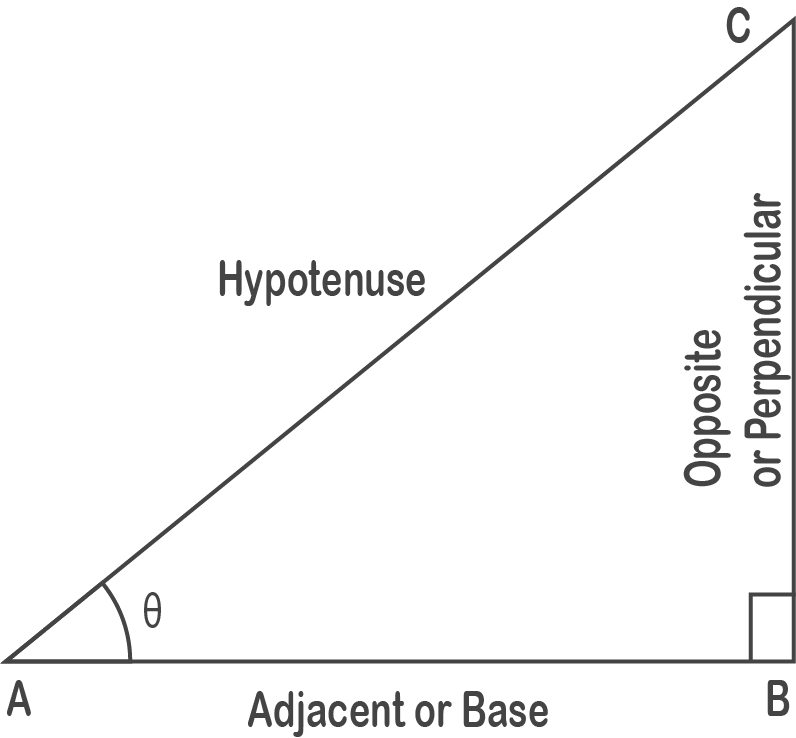
Parts of a Right Angled Triangle
- Hypotenuse: The side opposite the right angle. It is always the longest side
- Adjacent Side: The side next to the chosen acute angle, excluding the hypotenuse
- Opposite Side: The side directly opposite the chosen acute angle
The names opposite and adjacent depend on the reference angle, whereas the hypotenuse always remains the same.
The Six Trigonometric Ratios
- sin θ = Opposite ÷ Hypotenuse
- cos θ = Adjacent ÷ Hypotenuse
- tan θ = Opposite ÷ Adjacent
- cosec θ = Hypotenuse ÷ Opposite
- sec θ = Hypotenuse ÷ Adjacent
- cot θ = Adjacent ÷ Opposite
The first three are called the primary trigonometric ratios, while the remaining three are their reciprocals.
Reciprocal Relationships
- sin θ × cosec θ = 1
- cos θ × sec θ = 1
- tan θ × cot θ = 1
- cosec θ = 1/sin θ
- sec θ = 1/cos θ
- cot θ = 1/tan θ
Therefore,
Relationship Among the Ratios
sin θ = Opposite ÷ Hypotenuse
cos θ = Adjacent ÷ Hypotenuse
it follows that
tan θ = sin θ ÷ cos θ
Similarly,
cot θ = cos θ ÷ sin θ
These relationships allow one trigonometric ratio to be expressed in terms of another.
Range of Trigonometric Ratios
- 0 < sin θ < 1
- 0 < cos θ < 1
- tan θ > 0
- cosec θ ≥ 1
- sec θ ≥ 1
- cot θ > 0
Since the hypotenuse is always the longest side:
- sin θ and cos θ are always less than 1.
- cosec θ and sec θ are always greater than or equal to 1.
- tan θ and cot θ are always positive.
These observations are useful for checking whether a calculated trigonometric ratio is reasonable.

Summary of Trigonometric Ratios
| Concept | Summary |
|---|---|
| Hypotenuse | The side opposite the right angle. It is always the longest side of a right-angled triangle. |
| Adjacent Side | The side next to the reference angle, excluding the hypotenuse. |
| Opposite Side | The side directly opposite the reference angle. |
| sin θ | Opposite ÷ Hypotenuse |
| cos θ | Adjacent ÷ Hypotenuse |
| tan θ | Opposite ÷ Adjacent |
| cosec θ | Hypotenuse ÷ Opposite = 1 ÷ sin θ |
| sec θ | Hypotenuse ÷ Adjacent = 1 ÷ cos θ |
| cot θ | Adjacent ÷ Opposite = 1 ÷ tan θ |
| Important Relationships | tan θ = sin θ ÷ cos θ, cot θ = cos θ ÷ sin θ, sin θ × cosec θ = 1, cos θ × sec θ = 1, tan θ × cot θ = 1. |

Common Mistakes
- Confusing the Opposite and Adjacent Sides:
Students often identify the opposite and adjacent sides incorrectly. These sides always depend on the reference angle θ, while the hypotenuse is always the side opposite the right angle. - Using the Wrong Trigonometric Ratio:
Students sometimes apply the formula for one trigonometric ratio in place of another. Always identify the required ratio before substituting the side lengths.
Formulae:
sin θ = Opposite ÷ Hypotenuse
cos θ = Adjacent ÷ Hypotenuse
tan θ = Opposite ÷ Adjacent - Ignoring Pythagoras’ Theorem:
Students often try to calculate a trigonometric ratio without first finding the missing side of the triangle. Whenever two sides are known, use Pythagoras’ theorem to determine the third side before evaluating the required ratio.
Formula:
Hypotenuse² = Opposite² + Adjacent² - Confusing Reciprocal Ratios:
Students sometimes assume that sec θ is the reciprocal of sin θ or that cosec θ is the reciprocal of cos θ. Remember that cosec θ is the reciprocal of sin θ, sec θ is the reciprocal of cos θ, and cot θ is the reciprocal of tan θ. - Failing to Simplify the Final Answer:
Students often leave trigonometric ratios in an unsimplified form. Always reduce fractions to their lowest terms and rationalise the denominator wherever required.
Practice Questions
Question 1: A right-angled triangle has an area of 540 cm² and one of its legs is 24 cm. Find all six trigonometric ratios for the angle opposite the shorter leg.
Question 2: If sin θ = 3 cos θ, find all six trigonometric ratios.
Question 3: In a right-angled triangle, sec θ = 17/15 and the difference between the hypotenuse and the adjacent side is 14 cm. Find the lengths of all three sides.
Question 4: In a right-angled triangle, sin θ = 8/17 and the sum of the opposite side and the hypotenuse is 150 cm. Find the lengths of all three sides.
Question 5: A right-angled triangle has an area of 1260 cm² and the difference between its two legs is 7 cm. Find sin θ, cos θ and tan θ for the angle opposite the shorter leg.

Related Topics
 |
|
|
|
|
|